

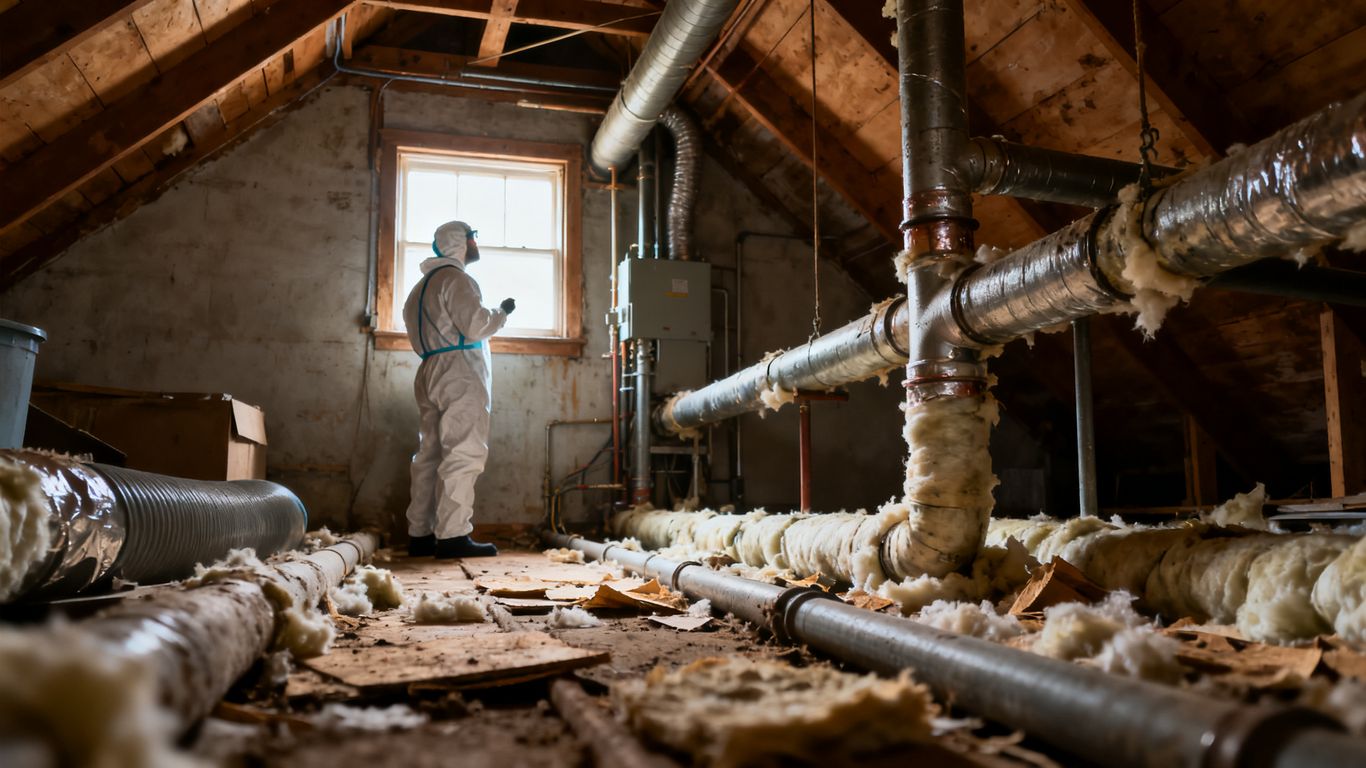
Asbestos is a naturally occurring mineral fiber once valued for heat resistance, strength, and durability. In an older building, the material may remain harmless when firmly bound and left alone, but deteriorating asbestos materials can release fibers into the air. The danger is usually invisible, which makes careful management more reliable than guesswork.
How asbestos fibers become airborne
Asbestos fibers become airborne when asbestos-containing material breaks apart, loses its binding matrix, or is disturbed by physical force. Cutting, scraping, drilling, sanding, and aggressive cleaning can all create conditions in which fibers separate and remain suspended long enough to be inhaled.
Why aging materials can release fibers without visible dust
Age can weaken the coatings, binders, and surfaces that hold asbestos fibers in place. Moisture, heat cycling, corrosion, and ordinary friction may loosen fibers even when no obvious cloud of dust is visible. A clean-looking room therefore does not prove that the air is free of contamination.
The difference between friable and nonfriable asbestos
Friable asbestos can be crumbled or reduced to powder by hand pressure when dry, making it particularly vulnerable to releasing fibers. Nonfriable material is more tightly bound, but it can still become hazardous if cut, broken, weathered, or otherwise damaged. Classification describes condition and behavior, not a license for untrained handling.
Why disturbance increases exposure risk
Disturbance changes a stable material into a potential emission source. Even a small repair can affect a larger area if tools, clothing, ventilation systems, or foot traffic spread fibers beyond the original work location. Avoiding disturbance is the first safeguard until the material has been assessed properly.
Where asbestos may be found in aging buildings
Asbestos was incorporated into many products, so its location cannot be inferred from one building feature alone. Older schools, homes, factories, offices, and public buildings may contain it in mechanical, architectural, and exterior components. Building age and records can guide an assessment, but they do not replace sampling by a qualified professional.
Insulation, pipe coverings, and boiler components
Pipe insulation, boiler jackets, duct coverings, and associated fittings may contain asbestos, particularly in older mechanical rooms. These materials can deteriorate from heat, leaks, maintenance access, or impact. Mechanical spaces should be treated cautiously because cramped conditions can make accidental disturbance more likely.
Floor tiles, adhesives, and textured coatings
Vinyl floor tiles, sheet flooring, mastics, patching compounds, and textured wall or ceiling coatings are possible locations. Removing flooring or scraping a finish can create dust and debris, even when the visible surface appears ordinary. A renovation plan should address underlying layers rather than only the top finish.
Roofing, siding, cement products, and exterior materials
Asbestos may occur in roofing products, siding, cement sheets, pipes, and other exterior materials. Weathering can erode surfaces, while drilling, sawing, pressure washing, or storm damage may release fibers. Exterior work still requires controls because fibers can enter occupied spaces or settle on surrounding grounds.
Fireproofing, ceiling systems, and sprayed applications
Sprayed fireproofing, acoustic coatings, ceiling tiles, and fire-resistant boards may contain asbestos in older construction. Some sprayed applications are soft and easily damaged by vibration, leaks, or building work. Guidance on common asbestos locations can help readers understand why apparently unrelated building systems deserve attention.
Recognizing potential deterioration without disturbing materials
A visual review can identify warning signs, but it should be observational only. The reviewer should not touch, scrape, move, or collect a piece of suspect material. Photographs and written notes can preserve useful information for a professional without turning the inspection itself into an exposure event.
Crumbling, delamination, water damage, and abrasion
Crumbling edges, peeling layers, delamination, water staining, and worn surfaces suggest that a material may no longer be intact. Frayed insulation and impact marks are also reasons to keep people away. These signs indicate a condition concern, not proof that asbestos is present.
Damage caused by renovations, maintenance, and vibration
Recent drilling, ceiling access, pipe work, flooring replacement, or equipment vibration may have disturbed hidden materials. Repeated contact from doors, ladders, carts, and maintenance tools can gradually wear protective surfaces. Work histories are therefore as valuable as the current appearance of the room.
Why visual inspection cannot confirm asbestos
Many asbestos-containing products resemble non-asbestos materials, and many non-asbestos products can look fibrous or damaged. Only appropriate sampling and laboratory analysis can confirm composition. Until that process is complete, suspect material should be managed as though it contains asbestos.
Situations that require immediate access restrictions
Access should be restricted when material is actively shedding debris, has been damaged across a large area, or was disturbed during an unplanned event. Leaks, fires, demolition accidents, and major maintenance failures warrant prompt escalation. People should leave the area without tracking debris through adjacent rooms.
Health risks linked to airborne asbestos fibers
The principal route of asbestos exposure is inhalation of airborne fibers. Once inhaled, fibers can lodge in respiratory tissues and contribute to inflammation and scarring over time. Public health information on asbestos health risks explains why exposure history matters even when a person feels well.
How fibers enter and remain in the body
Small airborne fibers can travel deep into the lungs when a person breathes contaminated air. Some may remain in tissue because the body cannot readily break them down or remove them. Risk depends on the circumstances of exposure, not simply on whether a building contains asbestos.
Asbestosis and other long-term respiratory effects
Asbestosis is a progressive scarring disease that can reduce lung function and cause breathlessness. Exposure may also contribute to other persistent respiratory problems, particularly when exposure is repeated or substantial. Medical evaluation should be guided by a clinician familiar with the person’s history.
Mesothelioma and asbestos-related lung cancer
Asbestos exposure is associated with mesothelioma and lung cancer, both serious diseases that may develop after a long latency period. Smoking can further increase lung cancer risk in people exposed to asbestos. No one should interpret a single exposure event as a diagnosis, but suspected exposure should be documented.
Why symptoms may appear decades after exposure
Asbestos-related disease often develops slowly, and symptoms may not appear until many years after exposure. This delay can make it difficult to connect illness with a past workplace, home, or renovation. Preserving records of buildings, tasks, dates, and protective measures can help clinicians assess later concerns.
Factors that influence exposure risk
Exposure risk is influenced by fiber concentration, duration, frequency, material condition, work methods, ventilation, and the type of fibers involved. Personal health history and smoking status may also affect outcomes. The safest approach is to reduce exposure at its source rather than trying to estimate a harmless threshold.
What to do when deteriorating materials are suspected
A suspected release should be handled as a control problem, not a do-it-yourself cleaning task. The immediate priorities are to stop activities, prevent spread, and obtain competent advice. A practical asbestos response guide reinforces the need to avoid disturbing suspect materials while arranging professional assessment.
Stop work and limit access to the affected area
Anyone who notices damaged suspect material should stop the task and calmly move away. Doors can be closed when appropriate, and occupants should be kept out until the area has been evaluated. Building managers should record what happened, who may have been present, and whether ventilation was operating.
Avoid sweeping, drilling, sanding, or removing debris
Dry sweeping and ordinary vacuuming can spread fibers rather than remove them safely. People should not pick up fragments, shake contaminated clothing, or use household tools on the material. The area should remain undisturbed while qualified personnel determine the appropriate controls.
Contact a qualified asbestos professional
A qualified asbestos professional can inspect the location, assess condition, arrange sampling, and recommend repair, containment, or removal. Selection should account for applicable licensing and training requirements. Building owners should provide the professional with renovation plans and any available construction records.
When air monitoring and laboratory testing may be appropriate
Laboratory testing may be appropriate when material identification will affect maintenance, occupancy, repair, or renovation decisions. Air monitoring may be considered when fibers may have been released or when regulated work requires evidence about conditions. These activities should be designed and interpreted by competent professionals rather than improvised by occupants.
Managing asbestos in occupied and aging buildings
Asbestos management is an ongoing building responsibility, not a one-time reaction to visible damage. The right response depends on material condition, location, likelihood of disturbance, and the needs of occupants. A written program helps ensure that maintenance decisions remain consistent when staff or contractors change.
Repair, enclosure, encapsulation, and removal options
Depending on the circumstances, professionals may recommend repair, enclosure, encapsulation, or removal. Repair can address localized damage, while enclosure or encapsulation may isolate material that can remain in place. Removal is not automatically the best answer; the decision should follow a documented assessment and regulatory requirements.
Developing an asbestos management plan
A management plan typically identifies suspect materials, their locations, condition, responsible personnel, work controls, and review dates. It should explain how workers request access and how planned changes trigger reassessment. The plan must be clear enough for a maintenance worker to use before opening a wall or ceiling.
Protecting children, occupants, and maintenance workers
Children and occupants may be exposed through ordinary activity near damaged materials, while maintenance workers face risk during access and repair. Protecting children from asbestos begins with keeping suspect areas inaccessible and preventing dust from being carried into occupied rooms. Staff should know whom to contact before performing work that could disturb building materials.
Maintaining records after inspection or abatement
Records should include survey findings, laboratory reports, plans, work documentation, waste records, clearance information when applicable, and notices provided to occupants. They should be stored where future managers and contractors can find them. Good records prevent repeated uncertainty and support safer decisions during later projects.
Responding to water intrusion, fires, and other emergencies
Emergencies can damage materials quickly and make normal procedures impractical. The area should be isolated, cleanup should be deferred to qualified responders, and utilities or ventilation should be managed to limit spread when safe to do so. After the immediate danger passes, the building should receive a documented assessment before normal use resumes.
Preventing exposure during renovation or demolition
Renovation and demolition create the greatest potential for deliberate disturbance of hidden materials. A building that appears safe during routine occupancy may present substantial risk once walls, floors, ceilings, or mechanical systems are opened. Planning before work begins protects workers, occupants, neighbors, and the project schedule.
Conducting a pre-renovation asbestos survey
A pre-renovation survey should identify materials that may be disturbed by the planned scope of work. The survey may require access to concealed spaces and representative sampling by qualified personnel. Work should not begin merely because no asbestos is visible on the finished surface.
Choosing licensed contractors and accredited laboratories
Owners should verify contractor credentials, required licenses, training, insurance, and relevant experience before awarding work. Laboratories should be appropriately accredited for the analyses being requested. Clear contracts should identify responsibilities for containment, waste, documentation, and final conditions.
Using regulated containment and decontamination procedures
Regulated asbestos work may require containment, negative pressure, controlled entry, protective equipment, wet methods, specialized cleaning, and decontamination procedures. The exact controls depend on the material and jurisdiction. Workers should follow the project-specific plan rather than adapting ordinary construction methods.
Meeting federal, state, and local requirements
Asbestos requirements can vary by building type, work size, location, and material condition. Owners and contractors should confirm notification, work-practice, waste, worker-protection, and clearance obligations with the relevant authorities. A useful building asbestos safety fact sheet also underscores that suspect materials should be treated cautiously until properly evaluated.
Communicating risks and reoccupancy conditions to building users
Occupants should receive timely, understandable information about affected areas, work timing, access restrictions, and the conditions for returning. Reoccupancy should occur only after the responsible professionals and applicable requirements indicate that the space is suitable for use. Clear communication reduces rumor, discourages unauthorized entry, and gives building users a practical way to report concerns.
