

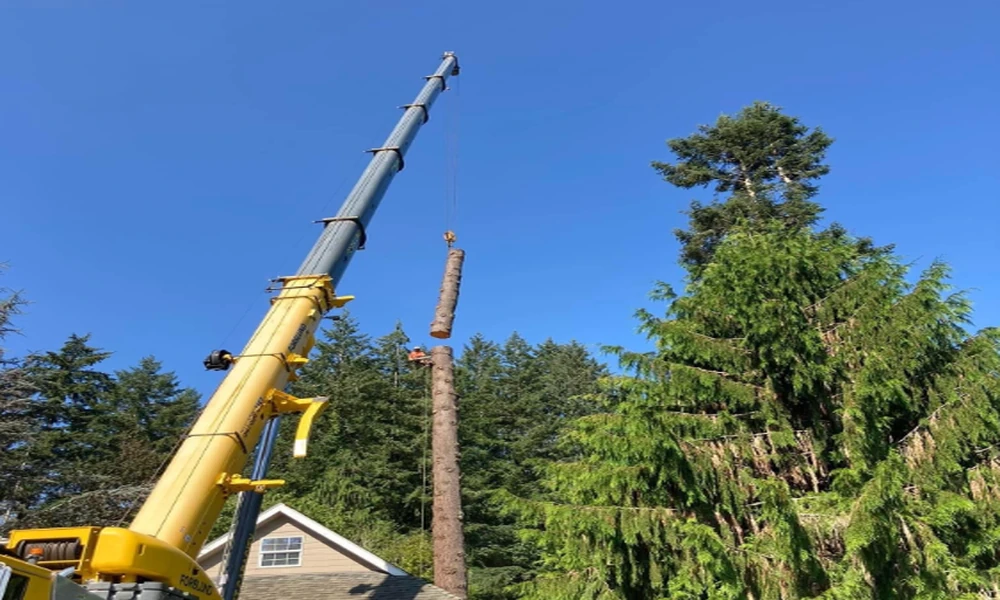
Removing a large tree is not always as simple as cutting it down. When a tall oak, pine, or another mature tree stands close to your home, there may not be enough room to bring it down safely in one piece.
That is when crane-assisted tree removal becomes an option.
But how much does crane tree removal cost, and why can one estimate be so different from another?
The answer depends on several things, including the tree’s size, its condition, access to the property, equipment requirements, and how much work is involved.
A crane can help workers lift heavy sections away from roofs, fences, and other obstacles. Still, bringing specialized equipment to a property adds costs that homeowners should understand before approving the work.
This guide explains what goes into a crane tree removal cost breakdown, when a crane makes sense, and how to compare estimates without overlooking important details.
Why Does Crane-Assisted Tree Removal Cost More?
Traditional tree removal often involves climbing, cutting branches, and lowering sections with ropes and rigging equipment.
That approach works for many trees, especially when the crew has enough space to control falling or lowered material.
However, some trees are too large, damaged, or close to buildings for ordinary rigging to be practical.
A crane allows workers to lift selected sections of a tree and move them to a designated landing area.
This can reduce the need to lower heavy pieces directly over vulnerable structures.
Of course, operating a crane involves additional planning and equipment.
The price may include crane transportation, setup, a qualified operator, lifting equipment, and extra coordination between the crane operator and tree crew.
Sometimes the crane makes the work faster. Other times, difficult access and complicated lifting conditions increase the total cost.
A crane is not automatically the safest or least expensive choice for every property. The removal method should follow a professional assessment of the tree and surrounding hazards.
How Much Does Crane Tree Removal Cost for a Large Tree?
Crane-assisted removal of a large tree can cost several thousand dollars, and particularly difficult projects may cost considerably more.
There is no reliable fixed price based on height alone.
For example, removing a large tree from an open yard may require less time than removing a smaller tree surrounded by roofs, fences, and utility lines.
A company may calculate its estimate using a combination of equipment expenses, labor, disposal costs, and site-specific requirements.
What Influences the Total Cost?
| Cost Factor | Why It Matters |
| Tree height and trunk diameter | Larger trees may require more lifting and cutting |
| Tree condition | Decay or structural damage can complicate the removal plan |
| Crane access | Limited access may require a different crane or setup |
| Crane operating time | Longer projects can increase equipment expenses |
| Distance to landing area | Greater lifting radius may affect crane selection |
| Crew size | Complex projects may require more workers |
| Debris removal | Large logs and heavy branches increase handling costs |
| Permits and traffic control | Additional arrangements may be needed near public roads |
| Stump grinding | Often priced separately |
These factors explain why two homeowners with similarly sized trees may receive very different estimates.
Crane Tree Removal Cost Breakdown: What Are You Paying For?
A professional tree removal estimate may combine several services into one price.
Understanding each component helps you compare proposals more accurately.
1. Crane Rental and Operating Time
The crane itself is often one of the largest expenses.
Crane pricing may be based on a minimum booking period, an hourly rate, or a larger project rate.
The size and lifting capacity of the crane also matter.
A larger machine may be necessary when tree sections are heavy or the crane must work from a greater distance.
However, a larger crane does not automatically mean a better solution.
Equipment should be selected according to the planned loads, operating radius, ground conditions, and available space.
2. Crane Transportation and Setup
Before the first branch is removed, the crane must reach the property and be positioned correctly.
This may involve transportation from another location, setting up outriggers, and preparing a stable working area.
Some companies include mobilization in their quoted price.
Others list it separately.
Ask whether the estimate covers delivery, setup, breakdown, and removal of the crane from the property.
3. Tree Removal Crew
The crane operator does not perform the entire removal alone.
Tree workers are needed to assess the tree, prepare rigging, make planned cuts, and manage material after it reaches the ground.
The crew may include a qualified climbing arborist, ground workers, and personnel responsible for coordinating lifting operations.
Labor costs vary with the number of workers and the time required.
Removing a large tree with extensive branching may take more work than removing a tree with a simpler structure.
4. Rigging and Safety Equipment
Crane-assisted tree removal requires equipment suited to the loads being handled.
This can include slings, approved lifting attachments, communication equipment, and personal protective equipment.
The crew must coordinate each lifting operation carefully.
These costs may not appear as separate line items, but they are part of professional crane tree removal pricing.
5. Cutting, Chipping, and Debris Removal
Once a tree section reaches the ground, it still needs to be processed.
Branches may be fed through a wood chipper.
Larger trunk sections may need to be cut into smaller pieces before loading.
Heavy wood can require additional handling equipment or transportation.
If you want all the wood and debris removed, ask whether complete hauling is included in the estimate.
6. Stump Grinding
Stump grinding is not always included in the original tree removal price.
Removing the standing tree and grinding the remaining stump are separate operations.
The stump’s diameter, surrounding roots, access, and requested grinding depth can affect pricing.
If you want the area ready for grass, landscaping, or another project, clarify what the stump grinding service includes.
Why Tree Size and Location Affect Crane Removal Costs
Tree size matters, but location can be just as important.
Imagine two mature oak trees of similar height.
One stands in the middle of an open property. The other grows behind a home, with branches extending above a screened patio.
The first tree may have enough space for traditional removal methods.
The second may require careful planning because workers cannot simply drop large sections into the yard.
A crane may allow the crew to lift pieces away from the structure.
However, the location of the crane, lifting radius, available landing area, and ground conditions will influence the equipment required.
This is why a contractor generally needs to inspect the property before providing a dependable quote.
When Is Crane-Assisted Tree Removal Necessary?
A crane may be considered when traditional removal methods create difficult working conditions.
Common situations include:
- Large trees growing close to houses
- Heavy branches extending over roofs
- Trees located near swimming pools or enclosed patios
- Storm-damaged trees with unstable sections
- Mature trees surrounded by limited open space
- Trees requiring controlled lifting over obstacles
The presence of nearby utility lines requires special attention.
Crane-assisted work near energized electrical equipment is particularly hazardous and may require coordination with the utility company and appropriately qualified personnel.
A crane does not automatically make work near power lines safe.
The removal plan must account for the applicable electrical clearance and safety requirements.
Is Crane Tree Removal Cheaper Than Traditional Tree Removal?
Sometimes, but not always.
Traditional tree removal may cost less when a tree stands in an open area and workers have adequate space to lower or fell material safely.
Without a crane, the project may require fewer expensive pieces of equipment.
However, traditional rigging can become labor-intensive when branches must be lowered individually around buildings or other obstacles.
In some cases, a crane may reduce the overall time required.
That can offset part of the additional equipment expense.
The most useful comparison is the complete project price, not just the hourly crane rate.
A lower equipment charge does not necessarily mean a lower final bill if the work requires many additional labor hours.
What Makes Large Tree Removal More Expensive?
Several site conditions can increase the cost of removing a mature tree.
Limited Property Access
A narrow driveway, locked gate, or backyard without equipment access can complicate the job.
The crew may need a different removal method or additional equipment.
Structural Damage or Decay
Dead limbs, trunk cavities, and other structural defects can make the tree less predictable.
These conditions may affect where workers can climb, attach equipment, or make cuts.
Nearby Buildings
Rooflines, sheds, fences, and pools can limit the available work area.
Protecting surrounding structures may require more time and a carefully coordinated removal sequence.
Ground Conditions
Soft soil, slopes, underground utilities, and sensitive paved surfaces may affect equipment placement.
Ground protection measures may be needed, but protective mats do not guarantee that lawns or driveways will remain undamaged.
Weather Conditions
Strong winds, storms, and poor visibility can delay lifting operations.
The crane operator and tree crew must determine whether conditions remain within equipment and operational safety limits.
A weather delay may also affect scheduling or equipment charges, depending on the contract.
How Can Homeowners Reduce Crane Tree Removal Costs?
There may be ways to reduce certain expenses without interfering with safe removal practices.
One option is to ask whether large logs can remain on the property instead of being hauled away.
This may lower disposal costs, although the wood will still need to be placed somewhere accessible and safe.
You can also ask whether stump grinding may be scheduled separately.
If several trees need removal, having them evaluated together may reduce repeated mobilization costs.
Preparing the property can also help.
Move vehicles, outdoor furniture, and other movable items away from the planned work area when directed by the contractor.
Avoid attempting to cut large limbs, move heavy logs, or assist with crane operations yourself.
Those tasks involve serious hazards and should be left to qualified workers.
What Should an Itemized Crane Tree Removal Estimate Include?
An itemized estimate helps you understand what is included before work begins.
A useful proposal might identify the following expenses:
| Estimate Item | What to Confirm |
| Site assessment | Whether the assessment is included |
| Crane mobilization | Delivery, setup, and removal |
| Crane operating time | Minimum hours and overtime charges |
| Tree crew labor | Scope of work included |
| Rigging equipment | Whether specialized equipment charges apply |
| Branch chipping | Whether brush will be removed |
| Log removal | Whether heavy trunk sections will be hauled |
| Stump grinding | Grinding depth and cleanup |
| Permits | Who is responsible for approval |
| Traffic control | Whether road or sidewalk restrictions are involved |
| Ground protection | What areas will be protected |
| Final cleanup | What condition the property will be left in |
Not every contractor separates all these expenses.
Some provide a single fixed project price.
That is fine, provided the scope of work and exclusions are clearly explained.
How to Compare Crane Tree Removal Quotes
The cheapest estimate is not always the most complete.
Two companies may be quoting different removal methods or cleanup responsibilities.
Before choosing a contractor, compare the actual services included.
Ask whether the proposal covers complete tree removal, hauling, stump work, and any necessary access arrangements.
You should also verify appropriate insurance coverage and ask about the qualifications of the workers involved.
If a separate crane company is being used, clarify which business is responsible for the equipment and how the work will be coordinated.
A written estimate can help prevent misunderstandings when the project begins.
How Arbor Wise Tree Service Approaches Large Tree Removal
Large tree removal requires careful planning, especially when trees stand close to homes and other structures.
Arbor Wise Tree Service serves property owners in the St. Petersburg, Florida area and offers tree removal services involving specialized equipment, including cranes when appropriate.
The company’s published service information describes evaluating tree conditions, access, and surrounding hazards before determining how removal should proceed.
For homeowners comparing crane-assisted removal with traditional methods, an on-site evaluation can help establish whether crane access is practical and what the complete removal scope may involve.
A clear written estimate should explain the proposed method, cleanup arrangements, and any separately priced services.
Frequently Asked Questions About Crane Tree Removal Costs
Does crane tree removal always cost more?
No. Although crane equipment adds expense, it can sometimes reduce labor time on complicated removals.
The final cost depends on the entire project, including equipment, access, labor, and cleanup.
How long does crane-assisted tree removal take?
The timeline depends on tree size, location, condition, and setup requirements.
Some projects can be completed within a day. More complicated removals may take longer, particularly when access restrictions or weather delays are involved.
Can a crane remove a tree from a backyard?
Sometimes.
The crane may be positioned in a driveway, street, or another suitable location, depending on access, ground conditions, lifting radius, and available capacity.
A site assessment is necessary to determine whether this approach is feasible.
Can I keep the wood to lower the cost?
Many contractors can discuss leaving selected logs or wood sections on the property.
Whether this reduces the quote depends on the removal plan and how the material would otherwise be handled.
Is stump grinding included in crane tree removal?
Not necessarily.
Stump grinding is frequently treated as a separate service, so ask whether it is included in the written estimate.
Why do crane tree removal quotes vary so much?
Different quotes may reflect different equipment, removal methods, crew requirements, risk assessments, and cleanup services.
Comparing the scope of work is usually more useful than comparing the total price alone.
Final Thoughts: Understanding Crane Tree Removal Costs
The cost of crane-assisted tree removal depends on more than how tall a tree stands.
Equipment selection, crane operating time, crew labor, access restrictions, tree condition, and debris handling all contribute to the final estimate.
A crane can make certain complicated removals more manageable, particularly when trees grow near structures or have limited space for traditional rigging.
However, it is not the best solution for every situation.
Before hiring a contractor, request a written estimate, ask about the removal plan, and make sure you understand which services are included.
Arbor Wise Tree Service can evaluate large-tree removal needs and discuss appropriate options based on the property’s conditions.
The goal is not simply to find the lowest price. It is to choose a properly planned removal method that addresses the risks, protects people, and provides a clear understanding of the work being performed.
This post was written by a professional arborist at Tree Trimming Saint Petersburg FL. Robert Miller is the owner of Arbor Wise Professional Tree Care, a locally owned and operated tree service company that offers superb lawn care by the most experienced Arborists. Arborwise Tree Services is a tree removal company that offers stump removal, tree pruning, stump grinding, fertilization, and tree restoration. We have an extraordinary lawn care industry notoriety covering the Pinellas county area.
