

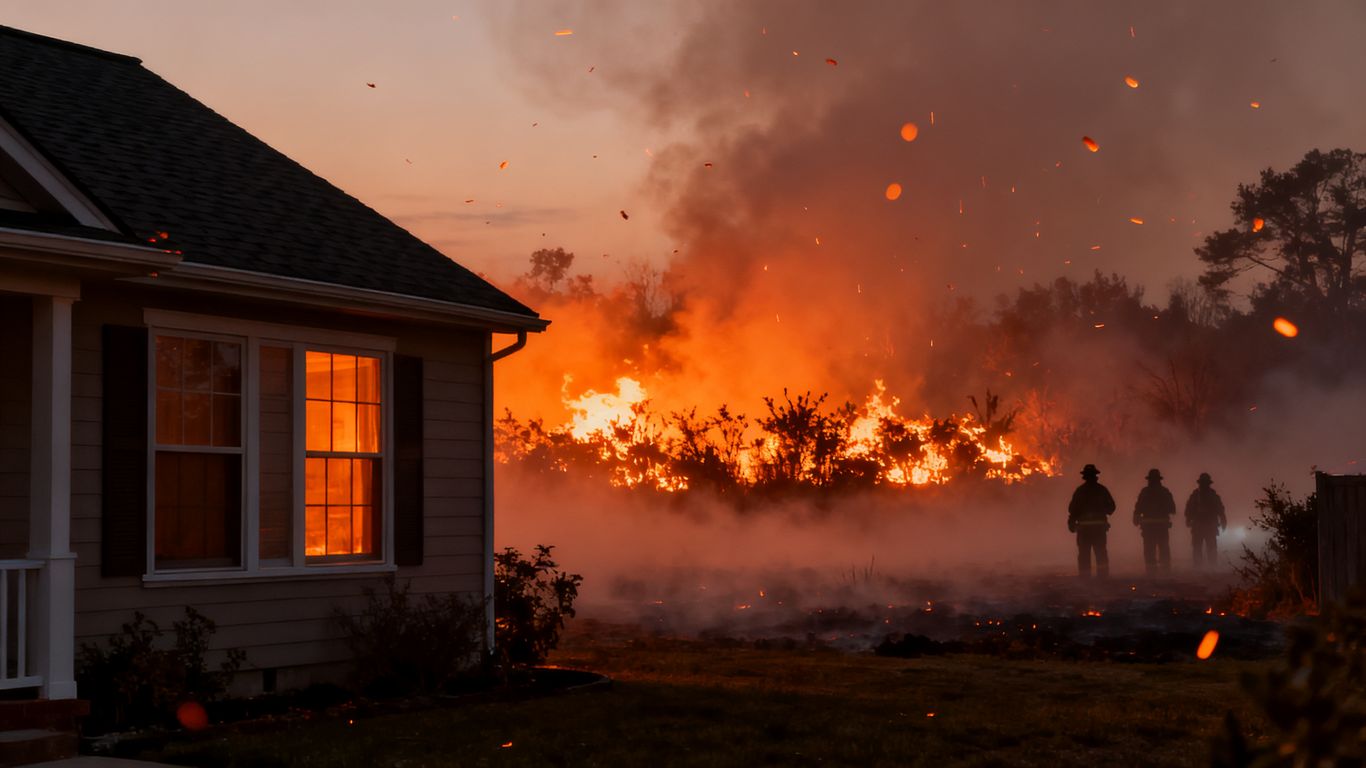
Radiant heat is energy emitted by a hot fire and carried through the air as invisible electromagnetic waves. Unlike flames, it does not need to touch a wall or roof to raise the temperature of that surface. For homeowners, understanding this exposure helps explain why radiant heat damage from wildfires can begin before a structure is visibly burning.
The difference between radiant heat, flames, and embers
A wildfire can threaten a house in three related but distinct ways: direct flame contact, radiant heat, and embers. Flames transfer heat by touching surfaces and moving hot gases around them. Radiant heat travels across open space, while embers are burning or glowing pieces of vegetation and buildings that can land in cracks, gutters, vents, or other vulnerable locations. The radiant heat transmission produced by an uncontrolled fire is invisible, but its effects on people and materials can be severe.
The distinction matters because a wall may be exposed to intense heat even when flames remain several feet away. Embers create a separate ignition route, often penetrating small openings or accumulating on combustible surfaces. A complete wildfire assessment therefore considers all three exposures rather than treating visible flames as the only danger.
How wildfire intensity affects radiant heat exposure
The hotter and larger a fire becomes, the more radiant energy it can release. Flame height, flame width, the amount of fuel burning, and the duration of the burn all influence how much heat reaches a nearby building. A low grass fire may pass quickly, while a fire involving dense shrubs, trees, fences, or neighboring structures can produce a much stronger and longer exposure.
Radiant heat also changes as the fire moves through different fuels. A fire that reaches the crowns of trees can expose structures from a higher and broader flame front than a surface fire. Measurements and estimates of wildfire temperature vary with fuel and conditions; wildfire heat is therefore best understood as a changing exposure rather than a single fixed value.
The role of distance, wind, and terrain
Distance generally reduces radiant heat because the energy spreads over a larger area as it travels. Even so, a nearby burning tree, fence, deck, or outbuilding can become a powerful heat source close to a house. Wind can tilt flames toward a structure, carry hot gases across its exterior, and move embers into areas that would otherwise be sheltered.
Terrain affects both the direction and speed of fire spread. Fire often moves more rapidly uphill because rising heat preheats vegetation above it. Slopes, canyons, walls, and dense vegetation can also channel heat and flame, creating uneven exposure across a neighborhood. A house may receive substantial heat from a fire that is not directly visible from every side of the property.
Why radiant heat can damage a home without direct flame contact
A material absorbs radiant energy at its exposed surface. As the surface warms, moisture leaves, finishes degrade, and the material can lose strength or begin to decompose. Windows may crack, sealants may fail, and painted or plastic components may soften before flames arrive.
Distance does not guarantee safety. A structure separated from flames can still suffer damage when exposure is intense or prolonged. The result depends on the fire, the building material, the geometry of the structure, and the presence of nearby objects that reflect or concentrate heat.
How radiant heat damages exterior building materials
Exterior materials do not all respond to heat in the same way. Glass, vinyl, wood, metal coatings, composite products, and roofing materials each have different limits and failure patterns. The first visible damage may be cosmetic, but it can also create openings through which embers, flames, and hot gases enter.
A post-fire inspection should examine both the material itself and the assembly around it. A wall covering may appear intact while its fasteners, sheathing, insulation, or framing have been heat-affected. That is one reason surface appearance alone cannot establish that a house is safe.
Windows, glazing, and frame failure
Windows are often vulnerable because glass can fracture under uneven heating. One part of a pane may be shaded while another is exposed to the fire, creating thermal stress. Multiple panes, tempered glass, frames, seals, and screens can each respond differently, and a failure in any one component may leave the opening exposed.
Radiant heat can also damage window coverings and furnishings inside a room. If glazing breaks, embers and flames gain a direct path into the building. Frames made from combustible or heat-sensitive materials may distort, loosen, or burn even when the surrounding wall remains standing.
Siding, paint, and exterior wall damage
Siding may blister, discolor, warp, crack, melt, or ignite depending on its composition and the intensity of exposure. Paint and sealants can fail first, leaving gaps at joints and around penetrations. Heat may also dry wood siding and make it more receptive to ignition from a nearby flame or ember.
Damage is not always uniform. Corners, joints, lower edges, and areas behind attached objects can receive different amounts of heat. A narrow strip of surviving siding does not necessarily mean the wall assembly escaped damage; heat can travel through cavities and affect materials behind the exterior finish.
Roof coverings and vulnerable roof edges
Roofs receive radiant heat from vegetation, neighboring buildings, and flames rising below them. Roof coverings can crack, curl, deform, or lose protective surface treatments. Their performance also depends on underlayment, decking, flashing, vents, gutters, and the condition of edges and valleys.
Roof edges deserve particular attention because they combine exposed materials with gaps and changes in geometry. Heat can collect beneath overhangs or around fascia boards. Once a roof covering or edge component fails, embers may reach combustible layers underneath and turn a localized weakness into a larger fire.
Decks, fences, and other combustible attachments
Decks, fences, trellises, arbors, sheds, and covered porches can burn near the house and expose walls and windows to intense radiant heat. These attachments also create horizontal surfaces where leaves, pine needles, and embers can accumulate. A fire beginning in an attached deck may reach the house even if the main structure has fire-resistant exterior materials.
The relationship between an attachment and the wall matters as much as the attachment’s material. Gaps beneath decks, enclosed staircases, and stored items can shelter heat and embers. Removing accumulated fuel and maintaining separation can reduce the chance that an exterior fire will become a structural fire.
How wildfire radiant heat causes a house to ignite
Ignition is a process rather than a single instant. A material first absorbs heat, then dries or decomposes, and may release flammable gases. If those gases mix with oxygen and encounter a suitable ignition source, a flame can develop and continue after the original heat source moves away.
The home ignition modeling research described in wildfire studies illustrates why exposure time, surface temperature, and nearby burning vegetation all matter. A house does not need to be engulfed at once; several small failures can create the conditions for sustained fire.
Surface heating and ignition thresholds
Every combustible material has conditions under which it may ignite, but those conditions vary with moisture, thickness, surface finish, airflow, and the presence of a pilot flame. Radiant exposure can raise a surface gradually, allowing heat to build before ignition occurs. A dry, weathered surface may respond differently from a newer or damp one.
Heat also continues to move through a material after the outside has cooled. This can leave warm cavities, smoldering insulation, or partially charred wood that later reignites. For that reason, a brief visual check immediately after the fire front passes may miss developing damage.
Heat transfer through windows and openings
Openings are weak points because they interrupt the continuity of the exterior shell. Radiant heat can fracture glazing, deform frames, and heat interior curtains or furnishings. Vents and small gaps can admit embers and hot gases, while damaged seals may allow smoke and heat to move into wall or attic spaces.
Once an opening forms, the interior contents can become the next fuel source. Furniture, paper, flooring, and stored materials may ignite even when the exterior wall has not. A room fire then exposes ceilings, framing, and adjacent rooms to a much greater heat load.
Combustible materials near the structure
Objects close to a house can absorb radiant heat and ignite before the building itself. A dry hedge, wood fence, stacked lumber, patio furniture, trash container, or firewood pile may act as an intermediate fuel. Its flames can sit directly beside siding or windows, multiplying the original exposure.
The most useful approach is to treat the area around a structure as a connected chain of possible fuels. Several modest hazards placed together may create a continuous path to the wall. Breaking that path is often more practical than trying to make every item completely noncombustible.
How small ignition points lead to structural fire
A single ember in a gutter or a small flame beneath a deck may produce little visible smoke at first. If the location is sheltered from rain and wind, however, it can smolder long enough to heat adjacent materials. Fire then spreads into cavities, roof edges, wall assemblies, or attic spaces where it becomes difficult to detect.
The sequence is often cumulative: radiant heat weakens an exterior component, an ember or nearby fuel provides ignition, and the resulting fire reaches the structure. This is why a building that appears mostly intact may still require immediate examination before occupants return.
Which parts of a home are most vulnerable
Wildfire exposure is rarely even on all sides of a house. Architectural details, nearby fuels, wind direction, and the slope around the building create local areas of higher risk. Small openings and sheltered recesses can be more consequential than large, exposed wall surfaces.
A vulnerability review should follow the exterior shell from the ground up. It should include places where materials meet, where air enters, and where debris can collect. Those details frequently determine whether radiant heat remains exterior damage or becomes an interior ignition.
Eaves, soffits, vents, and other openings
Eaves and soffits can trap hot gases and embers beneath the roof edge. Vents provide necessary airflow for attics and crawl spaces, but ordinary openings may allow embers to enter. Heat-sensitive screens, damaged louvers, and gaps around pipes or cables can further reduce protection.
The underside of an overhang may receive heat from vegetation or an attached deck below. If the soffit is combustible or has unsealed joints, ignition can spread into the roof cavity. These areas should be inspected closely during both pre-fire hardening and post-fire evaluation.
Roof-to-wall connections and enclosed spaces
Where the roof meets the wall, flashing, trim, gutters, and fascia create multiple joints. These components can warp or separate under heat, leaving pathways into the attic or wall cavity. Enclosed spaces beneath porches and decks present similar concerns because they may conceal burning material.
A continuous exterior surface is easier to protect than one interrupted by numerous gaps. Maintenance therefore matters: loose trim, cracked sealant, clogged gutters, and deteriorated vents can convert small heat exposure into a more serious weakness.
Garages, porches, and attached structures
Garages and porches often contain large openings, stored combustibles, and roof connections that link them to the main house. A garage door may deform or lose its seal under radiant heat, while stored fuel, cardboard, tools, and household goods can sustain a fire inside. Attached structures can also cast heat directly onto the home’s walls and windows.
The connection between these spaces should be evaluated as part of the whole building. A fire-resistant main wall offers less protection if a porch roof, garage eave, or enclosed breezeway carries fire around it. Separation, maintenance, and careful storage all reduce that vulnerability.
Landscaping and combustible items in the defensible space
Vegetation and household items within the defensible space can become local sources of radiant heat. Dry shrubs beneath windows, mulch against siding, wood fencing connected to the house, and furniture left beside a wall all deserve attention. The goal is not simply to create a bare ring but to reduce the continuity and intensity of fuels around the structure.
A practical property review can begin with four questions:
- Can vegetation or stored material burn directly against the house?
- Can a fence or deck carry fire toward a wall or window?
- Can leaves and embers collect beneath, on top of, or inside an attachment?
- Can firefighters or residents safely access the vulnerable side of the building?
These questions turn the broad idea of defensible space into specific maintenance decisions. They also help identify radiant heat pathways that may not be obvious from the street.
Factors that increase radiant heat damage from wildfires
Radiant heat damage depends on more than the peak temperature of a fire. Exposure is shaped by how much fuel burns, how long it burns, how close it is, and how the building receives the heat. The same house may fare differently in two fires because the surrounding conditions are different.
Understanding these variables supports better preparation and more cautious post-fire decisions. It also explains why no single material upgrade can eliminate every wildfire hazard.
Fire size, flame length, and burn duration
A larger flame front can expose more of a building at the same time. Taller flames may reach roofs, upper windows, and vegetation that would be above a smaller surface fire. Burn duration matters because a material receiving moderate heat for a long period may accumulate as much damage as one receiving a brief, stronger pulse.
Nearby fuel density can extend the exposure. Trees, shrubs, fences, decks, and adjacent structures may ignite one after another, keeping heat beside the house after the main wildfire has moved on. Fire behavior can therefore change from a passing event to a sustained local source.
Wind-driven flames and changing exposure
Wind can bend flames toward a structure and carry heat across gaps. It can also remove protective moisture from vegetation and move embers into gutters, roof valleys, vents, and sheltered corners. Gusts may change the exposed side of a house within minutes.
These shifting conditions make it dangerous to judge safety from a single observation. A wall that is clear of flames may later be exposed when wind changes direction or a nearby fuel ignites. Evacuation decisions should follow official emergency instructions rather than visual estimates from the property.
Building materials, age, and maintenance
Material type affects how a surface absorbs, conducts, and releases heat. Age and maintenance affect the same performance in less obvious ways. Cracked siding, open joints, dry wood, deteriorated roofing, clogged gutters, and damaged screens provide opportunities for heat and embers to reach more combustible layers.
Retrofits are most effective when they address the entire exterior system. Replacing one visible component may not resolve weaknesses at edges, vents, windows, or connections. A professional assessment can help prioritize work where the building’s condition and local exposure overlap.
Slope, vegetation density, and neighborhood layout
A steep slope can increase the speed and intensity of an approaching fire, while dense vegetation can produce taller flames and longer exposure. Homes close together may also receive radiant heat from neighboring buildings, fences, vehicles, or outbuildings. Narrow access routes can make suppression and evacuation more difficult at the same time.
Property-level preparation should therefore be coordinated with the surrounding neighborhood. A well-maintained house can still face intense heat from an adjacent unmanaged lot or connected fence line. Shared planning and clear access routes improve the protective value of individual improvements.
How to identify radiant heat damage after a wildfire
A structure exposed to wildfire should not be judged safe because it is still standing. Radiant heat may have weakened components, damaged seals, or started concealed smoldering. Smoke, ash, water, and firefighting activity can add separate hazards that are difficult to distinguish from heat damage without a careful inspection.
Occupants should wait for authorization from emergency officials before returning. Once access is permitted, observations should be documented from a safe distance, and damaged utilities or unstable materials should not be handled casually.
Signs of window and frame failure
Cracked or missing glass is an obvious warning, but less visible signs matter too. Frames may be warped, discolored, brittle, or separated from the surrounding wall. Screens, blinds, sealants, and interior coverings may show scorching even when a pane remains in place.
Windows should be checked for gaps, failed locks, broken seals, and heat damage around the trim. A pane that looks intact may still have lost its protective performance. Any opening that admits smoke, ash, or air should be treated as a potential route for embers or fire until evaluated.
Hidden damage behind siding and roof assemblies
Siding can conceal charred sheathing, burned insulation, damaged fasteners, or smoldering material. Roof coverings may hide heat-affected decking and framing, especially around vents, valleys, eaves, and areas where debris accumulated. Discoloration alone cannot show how far heat traveled through an assembly.
Evidence of hidden damage includes unusual odors, persistent warmth, soft spots, buckling, gaps, soot in joints, and newly sagging surfaces. Inspection methods may include selective removal, moisture assessment, thermal imaging, or other techniques chosen by a qualified professional. The method should fit the building and the suspected damage rather than relying on a single visual test.
Structural, electrical, and smoke-related concerns
Heat can affect load-bearing framing, connectors, wiring insulation, plumbing, and mechanical systems. Water used during suppression may cause additional deterioration or create electrical hazards. Smoke residue can contaminate surfaces and air-handling systems even where flames never entered.
Warning signs include leaning walls, shifted roof lines, sagging ceilings, unusual electrical odors, exposed wiring, damaged service equipment, and doors that no longer fit their frames. Occupants should avoid energizing circuits, using gas appliances, or entering unstable areas until the relevant professionals have cleared them.
When to involve a fire damage inspector or engineer
A qualified fire damage inspector can document visible and concealed concerns, while a structural engineer may be needed when framing, foundations, connections, or load paths appear compromised. Electrical and environmental specialists may also be appropriate depending on the property’s condition. Insurance documentation should be gathered without disturbing unsafe evidence.
Professional help is especially important when smoke or heat entered the attic, walls, crawl space, or HVAC system; when windows and roof edges failed; or when the building has visible movement. Early evaluation can distinguish repairable components from those requiring replacement and can reduce the chance that hidden damage becomes a later emergency.
How to reduce radiant heat damage from wildfires
Wildfire preparation works best as a combination of building improvements, fuel reduction, routine maintenance, and evacuation planning. No measure makes a home invulnerable, but reducing nearby heat sources and closing common pathways can improve its chances of surviving exposure. The wildfire mitigation guide provides a broader framework for considering direct flames, radiant heat, embers, and the home ignition zone together.
The work should be prioritized according to local fire behavior, property layout, construction, and available resources. Small maintenance tasks can matter, particularly when they remove continuous fuel or close a gap at a vulnerable edge.
Choosing fire-resistant roofing and siding
A roof with fire-resistant characteristics can reduce the chance that radiant heat and embers will ignite the upper structure. Roofing should be considered together with underlayment, decking, flashing, valleys, gutters, and vents. Siding choices should likewise account for joints, corners, penetrations, and the material behind the visible finish.
The most suitable products depend on local codes, climate, construction details, and professional guidance. A material described as fire-resistant is not automatically protective when poorly installed or surrounded by combustible attachments. Regular inspection and replacement of deteriorated components remain part of the defense.
Protecting windows, vents, eaves, and decks
Windows can be improved by selecting assemblies appropriate for wildfire exposure and by reducing combustible furnishings immediately beside them. Vents and eaves should be maintained, screened where appropriate, and checked for gaps or damaged components. Decks should be kept clear of leaves and stored items, with special attention to the space beneath and the point where the deck meets the wall.
These details deserve a planned inspection rather than occasional attention. A homeowner can walk the perimeter with a checklist, while a qualified contractor can evaluate assemblies that are difficult to reach or interpret. Improvements should never obstruct required ventilation or create a new maintenance problem.
Creating and maintaining defensible space
Defensible space is the managed area around a home where vegetation and other fuels are arranged to slow fire spread and reduce local radiant heat. It may involve pruning, removing dead material, separating shrubs from trees, relocating firewood, cleaning roofs and gutters, and breaking connections between fences and the structure.
Maintenance must continue through the fire season. Plants grow back, mulch dries, leaves collect, and outdoor items are moved. A property that was clear in spring may have several new ignition pathways by late summer, so periodic review is more useful than a one-time cleanup.
Combining home hardening with evacuation planning
Physical improvements protect property; evacuation planning protects people. Residents should know official alert systems, identify more than one route, keep essential documents and medications accessible, and plan for pets and anyone who may need additional assistance. The home ignition guidance reinforces that wildfire preparation requires coordinated action rather than a single building fix.
When an evacuation order is issued, residents should leave promptly and follow emergency instructions. Preparing a house does not justify delaying departure to defend it. The strongest plan combines sensible hardening, reduced fuels, clear communication, and an early decision to place personal safety first.
